
Showing posts with label Cornel West. Show all posts
Showing posts with label Cornel West. Show all posts
Wednesday, May 18, 2011
Cornel West Calls President Obama a Black Mascot
Your Black World reports
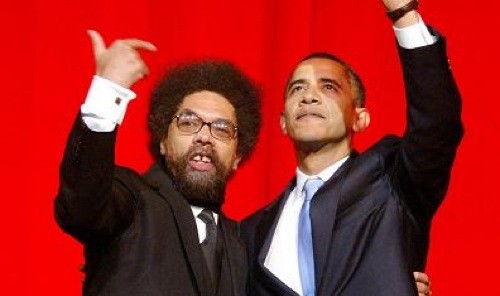
Cornel West spits fire at President Obama saying he is "a black mascot of Wall Street

Wednesday, October 22, 2008
YBW Interview W/ Dr. Cornel West On Obama, Colin Powell, Hip-Hop & More

Interview with Princeton Professor and acclaimed scholar, Dr. Cornel West, by Tolu Olorunda.
He is, perhaps, the most well-known public scholar the universe has to offer. Alongside that, Dr. Cornel West has also been celebrated as, America's leading public intellectual. Judging from his scholarly work, dedication, perseverance, intellectual curiosity and diligence, one can certainly confirm the role he plays as a distinct leader of his peers. Dr. West has continuously proved to be a multi-generational force for good. Through the publication of books, Hip-Hop albums and television specials aimed at young adults, Dr. Cornel West has impacted and transformed a whole generation of love-starved and directionless people. His wit notwithstanding, Dr. West's ability to interpret the harsh conditions of the financially-disempowered is parallel to none. I had the distinguished pleasure of engaging in dialogue with this esteemed scholar on a wide swath of issues affecting our daily lives. I spoke with him on issues including, the presidential campaign of Sen. Obama, Gen. Colin Powell’s endorsement, the role of progressives in an Obama administration, "Hope on a Tightrope," Hip-Hop, the next generation of Black public intellectuals, and much more:
Thanks for joining us. What has Dr. West been up to lately?
Oh, I’ve been on the moon. I did 15 events for Brother Obama in Ohio, this past weekend. I did 12, the weekend before that. I’ve been to Seattle, Alabama; teaching full time. I’m blessed though, brother.
How does it feel being a surrogate for Sen. Obama's historic presidential run?
Well, it’s a good thing, because in the end, it’s really about empowering everyday people, and he’s a major vehicle for that. He’s got some genius and inspiring people that give him a sense of possibility and hope. So, it’s a beautiful thing. But there’s always a tension there because I still got to speak my mind. So, I got my criticisms of the brother; but the most important thing to do, is a full-court press to get people out to vote, and to make sure that we contribute to this democratic awakening that’s taking place. This greed out here is running amok, man.
On the subject of greed; you've often talked about the melting of the Ice-Age. Do you feel the Democratic platform addresses poverty in a substantive fashion?
Well, it doesn’t address it as much as I would like. It opens the door, and acknowledges the fact that we need to start focusing on poor people, but it doesn’t hit the issue of poor people directly in the way that I would like. But at the same time, because it’s moving in that direction, I move with them – in order to bring pressure and power to bare, and hope that they would move with me in a substantive way. So, I’m never really satisfied with the Democratic platform – they’ve had a history of spinelessness and complicity toward injustice – but, on the other hand, because it’s so much better than McCain and the Republicans – and certainly, Brother Barack is so much better – I’m trying to get him into the White House and then deploy a vision and power on behalf of everyday people.
You know Sen. Obama personally. Has he met your standard of courage in matters concerning Muslims, the Black Community and War/Peace?
He’s met it enough for me to support him, but he hasn’t met it enough for me not to criticize him. It’s an area in between where, right now in the middle of an election, I do all that I can – putting in 16 hours a day without eating – to get him elected. But at the same time, I also know that he’s not Jesus. He’s not a Messiah or nothing. He’s a human being; a cracked vessel trying to do the best that he can.
What roles do progressives play in an Obama presidency; and what strategy do you suggest is best for success?
He’s only as strong as we are. I think that we have to be honest, diligent and candid about our focus on working and poor people. We have to talk strongly about public spending directly for education, quality jobs, health care, child care, infrastructure, bridges/roads, and home foreclosure. In that regard, we have to be willing to criticize him in order to make him stronger, and push him in a progressive direction. He’s not in a static position. He can be pushed.
Dr. West, one of your most famous blurbs is: "You can't lead people if you don't love them and you can't save people if you don't serve them." In your assessment, do you believe Sen. Obama has exhibited an encouraging amount of love and willingness for servitude?
I think so; definitely. As a presidential candidate, he’s got to be prudent. So he tends, for example, to focus on White moderates and independents. Why? Because he wants to win the election. So, in that regard, his willingness to love and serve is always under the framework of presidential politics. But I think that deep down he’s got a profound love and a sense of service. You see that, for example, in him being a community organizer instead of going to Wall Street, and some of his policies in the Illinois State house. And really, you can’t downplay the role of Sister Michelle Obama and those two precious girls [Malia and Sasha]. As Sly Stone said, it’s a family affair. When you talk about someone who is sharing a life with such a high quality person as Michelle Obama, that is very important – and it makes me feel good.
What’s your take on Colin Powell’s endorsement of Sen. Obama?
Courageous, eloquent, crucial; and I think it’s the last nail in the coffin of Republican/Conservative/Right Wing rule.
How critical is the concept of holding "President Obama" accountable; and what steps can be taken at this point to guarantee a desirable outcome?
Brother Tavis [Smiley] has been pushing this issue of accountability for a very long time, and was courageous to do it. In the end, this is not about any one person, or any one office. It’s about keeping everyone accountable. It’s about trying to gain Barack Obama access to the presidency, but keeping him accountable; because if we don’t have the kind of progressive policies that allow the empowerment of everyday people and working/poor people, we’re going to fly down the slope to chaos. Democracy cannot be sustained over a long period of time when there’s so much greed at the top, and the politics of fear is at play.
Switching gears: Your new book coming soon is, Hope on a Tightrope: Words and Wisdom. Can you briefly explain what its premise is?
It’s mainly that we are living in a moment where the American civilization is wavering, the American empire is wobbling, the culture is in decay, people are hungry and thirsty for vision, and we need some hope; but that hope is on a tight rope because we’re in a state of emergency. The first chapter of the book is: State of Emergency – a sense of urgency. Now, my view is that we were in a state of emergency many years ago – when people didn’t recognize. When you look at the dilapidated housing crisis, disgraceful school systems, unavailability of health care/child care, not enough jobs for living wage – that’s already a state of emergency for many brothers and sisters of all colors. But now that Wall Street has collapsed, it’s an indisputable, undeniable state of emergency across the board. But we need to sustain our hope on a tight rope, with a sense of grace and cool in the face of catastrophe – in order to empower everyday people.
Earlier in the campaign, Michelle Obama expressed some pride that "hope is making a comeback." Do you share similar sentiments, and what must we then do to sustain its balance?
Sister Michelle Obama is absolutely right. Keep in mind that hope is pitted against fear. For so long, people have been fearful. Hope is making a comeback, in part, because of Brother Obama’s brilliance, genius and charisma. He’s generating a sense of hope, but we’re still on that slippery tight rope, and we’ve got to be really courageous, bold and determined. We’ve got to have fortitude to help other people, and serve other people.
In light of Mrs. Obama's remarks, we have a financial meltdown that promises escalating despondency. To paraphrase Melle Mel, how does the Black Community keep from ‘losing its head’?
That’s a deep question. One thing we’ve got to realize is that, we’ve dealt with catastrophe before. We are a blues people, and the blues is: An autobiographical chronicle of a personal catastrophe expressed lyrically. But it’s always with a sense of grace and cool. And the country now has the blues. They either learn something from a blues people, or lose their democracy.
Do you believe we will survive this storm?
Well, it all depends on how much courage, vision and service we have. We might not survive it, because if greed, indifference, and fear continue, and McCain wins, there’s a good chance that we’re not going to survive it. But in the face of greed, we need justice; in the face of indifference, we need compassion; and in the face of fear, we need hope. That’s what Brother Obama represents.
Dr. West, there's a new class of Black public intellectuals - Eddie Glaude, Boyce Watkins, Marc Lamont hill - coming up. How confident are you that they can help raise the banner of truth and justice even higher?
Oh, I’m sure they will. We’ve got some serious young folks coming up. We’ve got Brother Tavis [Smiley], Bakari Kitwana, and a lot more. I’m impressed by a lot of the young brothers and sisters coming up. I’m satisfied that they’re going to surpass me; and that’s the reason I’m strong – to make them even stronger. They’re stepping forth with grace and dignity.
Your new Hip-Hop album, “Never Forget: A Journey of Revelations,” hit shelves earlier this year. What is your message to the younger generation; and why did you decide to use Hip-Hop as the avenue to facilitate that message?
Well, Hip-Hop is the universal language of youth culture. I was in Egypt, Belgium and Brazil; I walked into the clubs, and it was all Hip-Hop. So, because I’m an educator, I can write books and present a textual education, but with the CD, I can present a danceable education. I’m just trying to educate, and be educated. But most importantly, it’s just a matter of loving young folks and respecting them enough to learn from them. So it becomes a matter of reciprocity and mutuality in our awakening, and consciousness-raising. That’s what that CD is about. So you bring in artists like Prince, Andre 3000, Gerald Levert, Talib Kweli, KRS-One and Jill Scott – they are part and parcel of the conversation on the danceable education album.
On the subject of Hip-Hop, how can the present generation reshape and retake the culture, in a way that it represents, once again, a force for good, enlightenment and empowerment?
I think that one has to, first, support those crucial voices within Hip-Hop who are trying to take it to a new level. So, when Brother Lupe Fiasco talks about ‘the cool,’ you know, in fact, that he’s reflecting on a level of Hip-Hop artistry that goes beyond the dominant everyday perspectives. The same is true for Nas, with the “Untitled,” album. And there’s a whole host of others out there who need our support. I was just in the studio with Rhymefest for El Che. It’s a matter of acknowledging that we really do have voices in Hip-Hop, of the younger generation, that we need to be supporting. When you listen to Game and Lil’ Wayne talking about “My Life,” you’re moved, man. It’s coming from the soul. I love Lil’ Wayne’s dedication to his craft. He’s got to be the hardest working brother in Hip-Hop – just like my hero, James Brown. I try to be the hardest working man in the academy.
Lastly Dr. West; what message do you hope the general public grasps unto at this transitional moment in our earthly experience?
I think, at this particular moment, we need a strong democratic awakening that tries to push back the greed, indifference and fear. The first step is to try to get Brother Barack in the White House. The second step is to put pressure on him – so that he can engage in some of this public spending directly to the people and they can have access to health care, child care and jobs with a living wage. We need to get these home-owners to stay in their homes, so that these bankruptcy courts can re-adjust the mortgage. And we need a stimulus plan to get the economy running again. That’s the beginning of turning things around, so we don’t have a system tied only to the strong, but one that takes seriously the plight of the weak. So, it’s not just for the rich, but for the many.
Thanks for the time, Dr. West.
Watch Dr. Cornel West In Action:
This interview was conducted by Tolu Olorunda, Staff Writer for YourBlackWorld.com
Thursday, June 26, 2008
YBW Interview With Prof. Peniel E. Joseph

Interview with Harvard fellow, Peniel E. Joseph, by Tolu Olorunda.
Peniel E. Joseph is one of the nation’s leading scholars of African American history. Although Joseph’s formal expertise includes the Black Radical Tradition, Pan-Africanism, Black Social Movements, and African American feminism, he is currently embarking on a re-evaluation of the Black Power Movement. Professor Joseph is associate professor of African and Afro-American Studies and affiliate faculty in history at Brandeis University. Joseph is the founder of a growing subfield of historical and Africana Studies scholarship that he has named “Black Power Studies.” Joseph's dynamic presentation style and innovative scholarship, place him on the cutting edge of a new generation of public intellectuals. Joseph’s book “Waiting 'Til the Midnight Hour: A Narrative History of Black Power in America,” was a “Washington Post Book World” Best Nonfiction Book for 2006. It was also a finalist for the Mark Lynton History Prize. It received honorable mention for the 2007 Gustavas Myers Center Outstanding Book Award; and received the inaugural W.E.B. Du Bois Book Award from the Northeastern Black Studies Alliance. It was also a Boston Globe paperback bestseller in 2008. Joseph is currently working on a biography of Civil Rights and Black Power activist, Kwame Ture (Stokely Carmichael), and a study of postwar African American history. For the 2008-2009 academic year, Dr. Joseph will be a fellow at Harvard University’s Warren Center.
I had the pleasure of speaking with Dr. Joseph on a wide array of issues. With topics ranging from politics to culture, and education to sports, he was insightfully-enlightening in his observations:
Thanks for joining us. Can you tell us about your background, and the journey leading up to Harvard?
I’m from New York City, born and raised, and I’m just raised by a single mom. My mom was a trade unionist for 40 yrs in New York City – just retired. So, I was always into social and political activism; I was on my first picket line by the time I was 9 yrs old, so I was always active. I was always interested in Black history, Caribbean history, Asian history and African history, so after college I got my PhD from Temple University. At the same time, I was still involved in community and social activism. I wound up teaching at Arizona State University for a couple of years; then I taught at University of Rhode Island and Stony Brooks University in New York -- which is my alma mater. And now at Brandeis University, but this year, I’m a fellow at Harvard University.
Is the continued presence of Black and Brown intellectuals in Ivy League schools emblematic of any substantive progress for us?
Yes, I think it’s an example of progress, but I also think it that -- well, I’ll do the ‘positives’ first. I think it’s a tremendous example of progress, given the fact that when we think about higher education and academe, especially predominantly white institutions; these we’re set up as spaces for the white, elite and the rich. So as soon as you get any kind of African Americans in there, it’s very positive. And, obviously we owe a lot of these to people like Carter G. Woodson, W.E.B Du Bois and Ida B. Wells; the generation of the 19th and early 20th century intellectuals. Some we’re PhDs and others we’re just organic intellectuals in that degree, such as Marcus Garvey and Hubert Harrison. By the time you get to the 1960s, there’s really a second wave of Black Studies, vis-à-vis the Black Power movement that forces some of these predominantly white institutions to open up their doors, through the implementation of Black Studies majors in programs across the country. So that’s the positive. But the negative is the fact that I think most of these spaces are still overwhelmingly white and racist. So, having Cornel West, Michael Eric Dyson and Manning Marable is great, but at the same time, it provides cover for some of these racist institutions as well. So, you have this representative-nature of Blackness, but you don’t have enough Black Undergraduates, or Graduates, let alone Faculty and Administration; because we are sorely underrepresented in all those categories. It’s the same thing with Senator Obama. You might have a black president, but you might also see a lack of Blackness in the federal judges or the news-media. So, there’s the good and bad to the process.
What is your overall perspective on the Senator from Illinois -- especially being that he hails from your very Harvard?
Well, I’m a critical supporter of Mr. Obama, and what I mean by that is that I support Obama’s candidacy; and at the same time, I think that if he is elected, we have to be very vigilant and very critical. So that we force ‘President Obama’ to publicly confront things like, the Prison Industrial Complex and the pervasiveness/viciousness of institutional racism – locally nationally and internationally. But again, I think that trying to run for president is a hard thing to do.
Do you believe that Cynthia McKinney from the Green Party can help in exerting some ‘progressive-pressure’ upon the political landscape?
I think that Cynthia McKinney is obviously a very progressive person -– whom I admire. I think that when we talk of Cynthia McKinney, a lot of activists get confused with Third-Party runs and Community Organizing. Nowadays, some people think that ‘trying’ a Third-Party run - in and of itself - is community organizing, and there’s a problem there. I think that the bankruptcy of that strategy is shown when you have a candidate like Barack Obama, who’s actually energizing millions of people. The Third-Parties don’t seem to have a parallel-outreach and success. When people like Malcolm X and Kwame Ture would say, “We got to follow the people, because the people are ahead of us;” how come they’re following Obama? Masses of the American people are following Obama.
Do you think Senator Obama’s struggle for the White-House is one which we must all embrace?
I think we should be critically supportive of Barack Obama’s candidacy. We’ve seen a lot of debates over this. We saw Tavis Smiley come out and catch a lot of flak for it. But, I do like the idea of holding Barack Obama accountable, but I also feel that he’s in a very difficult position, because he is the first black man that could actually become president. I think the African American community should embrace his candidacy - but critically - and then really watch what’s going on, and try to influence it within the next four years. And then if our needs aren’t being addressed, we can begin making intelligent calculations on what to do next.
I’m sure you’ve heard of the Father’s Day Speech that he gave last Sunday. Did you have a problem with it, or did you feel that it was indeed a legitimate critique?
Well, certainly the speech was pandering, but if you’re from that background, where you’re raised by a single parent, you realize that you do need to speak to Black Men about this. And I thought Obama did it in a way that wasn’t quite as condescending as the way in which Bill Cosby did it in 2004. You have to talk about the politics of self-responsibility vis-à-vis our failures, and also the system that is perpetuating that failure, and that’s a dialogue that we haven’t had in a really complex way. If you’re speaking of the politics of self-determination, whether it’s Marcus Garvey or the Nation of Islam, you’re supposed take personal responsibility. But, one big issue with a Barack Obama presidency is that he might not be able to preach responsibility all across the board.
In matters of education, how does the next president rehabilitate the dilapidated public school system?
To be honest with you, all the president can do is propose laws to the Congress for passage. Certainly, he can give more money to public schools and have further accountability by putting more ‘teeth’ behind “No Child Left Behind;” but it’s really based on spending bills.
As an expert on issues pertinent to race, what are the major obstacles threatening our progress?
I think the biggest things are probably lack of access to higher education, the Prison Industrial complex and the Criminal Justice System. Unemployment, Violence and drugs also are power-brokers in our stagnancy. And we’re talking of Black Americans who happen to be part of the so-called “underclass.”
Do the recent victories of Tiger Woods and the Boston Celtic (being overwhelmingly black) have any substantial impact upon the lives of everyday black folk?
I think they might be an inspiration to some, but a Barack Obama presidency would be even bigger. You know, sports is different from politics, and I think if you have a black President, it will transform the way a lot of young people look at themselves. And, I think Obama’s presidency would bring about reverberations in other aspects of American society. I think that newspapers and television and media would be forced to re-examine aspects of how they’re made up vis-à-vis the shock of having a Black President.
What is your advice for the average brother and sister trying to gain access to higher education?
The pursuit of literacy would allow you to really excel; because, a lot of us are woefully unprepared after graduation from High School. The way it is now, so many of our people have a star-crossed relationship with school, and it is not perceived as something which would impact their lives. I think that what the older folks have to do is educate the younger ones about our history and the struggle that took place to get to this point. And, I think that can provide a context for a way to move forward in the present.
Once again, thanks for speaking with us Dr. Joseph.
This interview was conducted by Tolu Olorunda, Staff Writer for YourBlackWorld.com
Subscribe to:
Posts (Atom)